Rabbit farming is one of the most promising branches of animal husbandry. Rabbits are highly prolific and mature early: one doe can produce 5–6 litters a year, more than 30 kits and about 60–70 kg of rabbit meat in live weight.
Rabbit Farming Worldwide
Rabbit farming is developing in many countries, driven by a shortage of animal protein and, in developed countries, by the desire to diversify diets. According to 2013 data, the world produced between 1 and 3 million tonnes of rabbit meat. The leading producers were China, Italy, Spain, France and Ukraine: China produced 315–409 thousand tonnes of rabbit meat in carcass weight annually, Italy 221–300 thousand, France and Ukraine about 150 thousand each, and Spain 135–137 thousand tonnes. They were followed by the Czech Republic (38.5 thousand tonnes), Germany (34.0), Hungary (12.7), Russia (7.0) and Bulgaria (5.0).
The leading exporters of rabbit meat were China, Belgium, Poland, Hungary and Spain, and the main importers were Italy, Belgium, France, the United Kingdom and Switzerland. Per capita consumption of rabbit meat was about 6 kg a year in Italy and about 3 kg in France. Rabbit farming serves as a significant additional source of meat resources.
Directions of Development
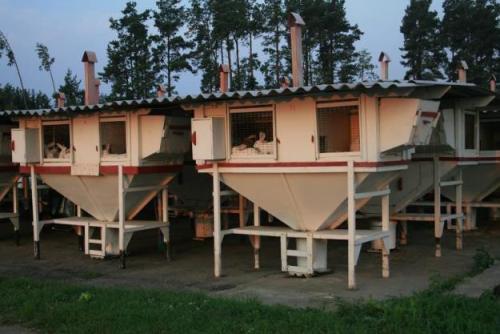
The main direction of the industry's development is technical re-equipment and the transition to industrial production. This places new demands on rabbit husbandry technology, on equipment for mechanisation and automation, and on the design of buildings and structures on which large rabbit farms and complexes are based.
In recent years, the economic appeal of rabbit farming has attracted new supporters to the industry. However, on many farms where rabbits have been raised for a long time, the technology has hardly changed. Keeping rabbits in buildings with a controlled microclimate, automating labour-intensive processes and feeding complete pelleted feeds help reduce production costs and increase productivity.