Production Section
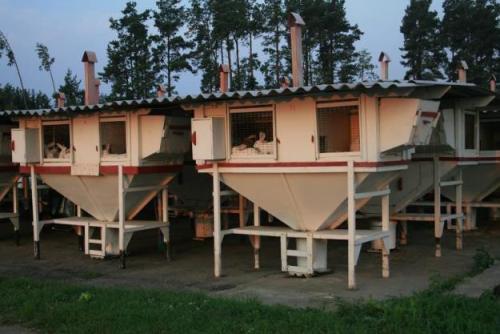
Breeding rabbits using our method involves keeping the animals in special mini-farms. A mini-farm is installed on an open site and takes up 1.4 m². It holds up to 30 rabbits, 13 on average.
According to the method's developer, one mini-farm requires 500 kg of compound feed and 250 kg of hay per year, and one accelerated-growth rabbit 14 kg of compound feed and 7 kg of hay. Output is one rabbit (4–6 kg) every 10 days, and capital turnover is about 100 days.
There are several mini-farm models, including two-tier ones. How many of them your farm will have is up to you: they do not require much space. For example, a farm of 16 mini-farms takes up about one sotka (100 m²) of a household plot. According to the developer, it can be tended once a week, and its output is about ten large rabbits per week.
Work on the farm is mechanized: there are hay feeders, an automatic drinker and a gravity-fed compound feeder, so, according to the developer, tending takes 30–40 minutes a week. The mini-farms need heating only when the temperature drops below +10 °C; power consumption is 30 W.
Training in the method was provided at the main farm in St. Petersburg, where literature and mini-farm drawings could also be ordered. Other farms also helped to set up such a business, for example Kaligula (Novosibirsk) and the BelAKRO educational, research and production complex (Belgorod) — the information is given as of 2013.
One farm is not enough to get the maximum return: it is advisable to organize processing of the products, sewing of goods from the pelts and production of vermicompost.
Costs and Income
Approximate figures from the original material (2013); they need to be updated before use.
- Building a mini-farm yourself or to order — from 5 to 20 thousand tenge without additional equipment.
- Output per mini-farm — from 100 kg of meat and 55–60 pelts.
- Payback period — from six to eight months.
- Efficient production is recommended from 300 mini-farms: costs of about 350 thousand tenge per year (excluding the cost of the farms and taxes), income of about 1.5 million tenge.
Overview
Many aspiring entrepreneurs, especially those with ties to the countryside, want to know how profitable rabbit breeding is. Below is an example of a business plan that covers the main aspects of such a business and helps draw conclusions about its profitability. Rabbits can be bred not only in villages, but also in the suburbs of large cities and in garden communities.
The business plan provides for opening a rabbit breeding farm to sell meat, liver and pelts. The legal form is a sole proprietorship (individual entrepreneur): this simplifies taxation, bookkeeping and settlements with buyers. The farm is designed for 60 head.
The project's chances of success are rated as moderate: demand for rabbit meat is low and depends on the region, so much depends on the ability to find buyers.
Market Analysis
In this section, describe in detail the market for similar farms in your region and list potential wholesale and retail buyers and their purchase volumes.
Production Plan
- Choose a plot of land, preferably with minimal rent. The minimum size is 5 sotkas (500 m²): enough for cages and outbuildings.
- Build or buy cages. Homemade cages from materials at hand save money, while ready-made ones are more convenient and functional.
- Buy the initial stock. This plan assumes 60 head: 20 bucks and 40 does.
- After stocking, hire a worker to look after the farm and buy compound feed.
Sales Plan
The sales plan must be settled before starting work, otherwise you may be left with surplus products. The main buyers are meat markets, supermarkets, private meat sellers and individuals. Pelts are often bought by fur workshops and fashion designers. Sales success depends largely on proximity to large cities.
Financial Plan
This section calculates the costs of setting up the farm and the potential income. Part of the offspring can be kept to expand the farm, and then volumes will grow proportionally.
Such a farm can pay for itself in less than a year, but this business has its own difficulties, so it suits those who are ready to take it seriously.