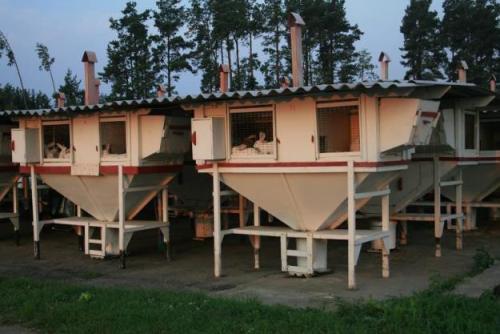
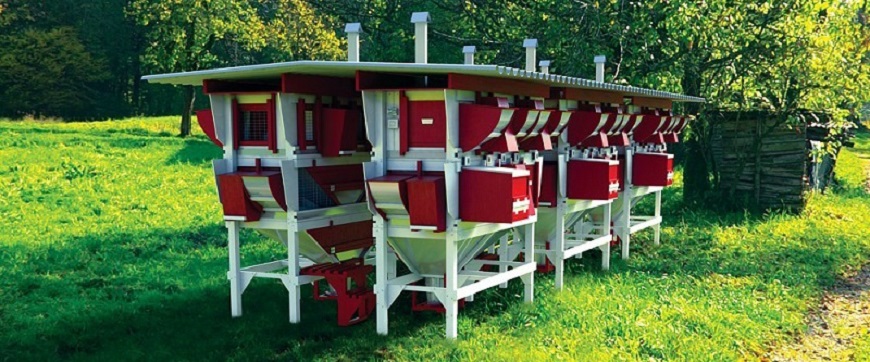
The open shed for young rabbits (like the other sheds on the farm) is 40 metres long and 3 metres wide. The cages are arranged in a single tier. The shed is open at the sides; the back walls of the cages are clad with wood, and the other walls are made of mesh.
Group Cage Design
To save money, the small group cages with an area of 0.6 m² are made non-removable. Hay racks are not needed: kits weaned at 45 days reach the hay through the ceiling mesh when the cages are 38–40 cm high. The mesh openings are enlarged (35×35 mm); as an exception, chain-link mesh with 50×50 mm openings will also do.
Additional savings come from dropping one of the adjoining partitions and the hay racks; the labour needed to build non-removable cages is also lower, and large-opening mesh is cheaper. For watering the kits, instead of two one-litre plastic buckets, a single 3-litre bucket is installed. It is taller than the one-litre bucket, but weaned kits can usually already reach the water; if necessary, a step can be placed for the first week. In the author's experience, such a bucket is suitable for watering kits.
With dry feeding, especially on pelleted compound feed, rabbits need a great deal of water, so the capacity of the drinkers has been increased. The more protein in the feed, the more water the animals require.
Three litres of water last 6–7 kits (exactly the number kept in a group cage) for 2–2.5 days. Another advantage of a tall drinker is that droppings do not get into it. A strip of izol roofing material is laid on the ceiling mesh: it protects the drinkers below from falling hay. The hopper feeders in the fattening unit have also been enlarged — they hold about 7 kg of concentrates, which is enough for 2–3 days.
The drinkers are mounted on the doors, and the tilting feeders on the rest of the front. The dimensions of the drinkers and hoppers determine the length of the cages — 80 cm; the cage depth is 75 cm, which makes it easy to reach any rabbit. The height from the cage floor to the ceiling mesh is 38–40 cm, and from the ground to the cage floor 1 m. The floors are slatted, made of wooden bars with a cross-section of 25×30 mm. In the author's experience, mesh floors are preferable for rabbits, but galvanized welded mesh with 16×48 mm openings is too expensive for many rabbit breeders. Mesh floors are not suitable for giant rabbits.
Daily Care
To keep the rabbits from gnawing the wooden bars, it is advisable to put branches of deciduous trees in the cages: rabbits love bark, which is rich in fibre, usually lacking with dry feeding. The rabbits can be fed and watered without opening the doors — everything is loaded and poured from the outside. This design makes it possible to tend the rabbits in a 40-metre shed in 20–30 minutes once a day. Hay is placed on the ceiling mesh with a supply for roughly a month; to keep the wind from blowing it away, the space above the cages up to the roof is closed off with a lattice of bars or metal mesh. Manure is removed once a month.
According to the author's calculations, with a farm area of 15 sotkas (0.15 ha) and 150 does (the workload for one rabbit breeder), 4,500–5,000 broiler-breed rabbits, or 7–8 t of rabbit meat, can be raised for meat per year.
Feeding During Fattening
On such a farm, slaughter takes place at 90–110 days of age; rearing of young rabbits and fattening are combined. The protein content of the feed should be 15–17% — this level is considered optimal for raising broilers. If succulent or green feed is given, labour productivity drops noticeably and the risk of losses increases.
Sudden changes of feed in the diet during the year are undesirable. If a change is unavoidable, make it gradually and carefully. Not all concentrates, even good-quality ones, suit kits: until their gastrointestinal tract has formed, the young are very vulnerable. The author of the original material recommended the complete compound feed PK-93 from the Zhabinka Feed Mill (Brest Region, Belarus); also suitable for young rabbits are compound feed for fingerling fish, which contains enzymes and a lot of protein, and compound feeds for young piglets, calves and poultry.
On small home farms, kits can also be fed wet mashes based on potato and pumpkin purée; clean feeders are a must.
If the rabbits are raised on compound feed, give them a vitamin and mineral premix. If there is no premix, add carrots to the diet, and in winter conifer branches and fish oil. With proper feeding and well-organized breeding selection, broiler kits can reach 3 kg at 2.5 months.
Cage turnover under this intensive technology is very high. There is no need to castrate the males: at this age there is usually no serious fighting between them. The author notes that with this technology it is possible to keep both the cages and the air clean. Complete compound feed contains up to 30% grass meal.